
Step-by-Step Guide to Creating DIY Irrigation Pipes
Step 1. Based on the length of the roots of the tree in feet, or the preferred length of the pipe you want, purchase the specific size from a hardware store called Lowe’s. Click this hyperlink to view the product. Since it is 10 feet, use a pipe cutter to the desired length. You can create up four or five of these for each of your trees if you prefer it to be around 1.5 feet long.
Step 2. Once bought, use a drill that can create different sizes of holes in the pipe. Make sure to use a marker before drilling the holes to mark the spot. Next few steps describe where to place the holes.
Step 3. Grab a marker and mark 1 hole on the lowest point of the pipe. Make another one directly on the other half of the pipe, so that the two holes are aligned and proportionate. This is created for drainage for the remaining water after irrigation.
Step 4. Using a ruler, measure 1.5 inches up, and mark 1 hole there. Around that same height, measure 3 other holes around it, as equally spaced as possible. Keep repeating this until you reach the holes made in step 5.
- Step 5. Draw a huge hole 3 inches down from the top of the pipe, and one on the opposite side directly across of it, just like the 2 small holes near the bottom.
- Step 6. Lastly, draw a circle to a even bigger size and you can put it anywhere near the top, wherever you prefer. This hole will be used for the water pipe, because you will enter the water pipe through this hole, to fill the whole drainage pipe with water.
- Step 7. Now drill the holes made in Step 3 with the smallest drill size bit, and use this same size for Step 4.
- Step 8. Change the drill bit to a bigger size, and drill the two holes that were create in Step 5.
- Step 9. Lastly, change the drill bit to a even bigger size and drill this one hole anywhere near the top, where you first marked it in Step 6.

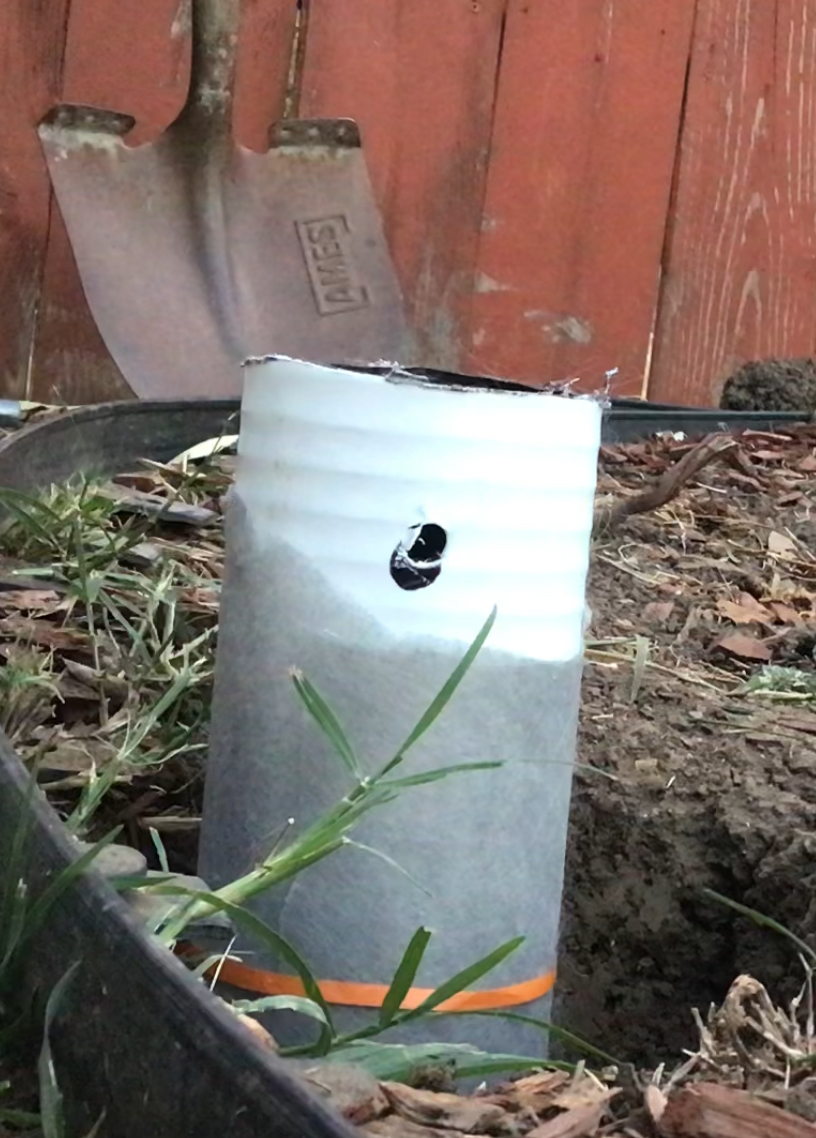
- Step 10. Now that your pipe has all the necessary holes, use Construction Adhesive Glue to glue a lid to the bottom of the pipe. We used a lid from a Pringles can, but you can try finding another reusable can that fits the pipe. Glue it carefully with gloves and wait around 24 hours to make sure that the it’s solidified.
- Step 11. Grab Weed Protector Cloth, and use scissors to cut enough from it that it wraps all around the pipe and then some more. This helps prevent rocks and other small pebbles from lodging into the holes and blocking it. Use a small rope or thread to tie the cloth around the pipe and cut just enough cloth from the top so that you can still access the top hole.
- Step 12. Use the Pringles Can and cut slices from the top, so that it’s equally cut into eighths. Then try to bend and fold it all together so that it can fit on the top of the pipe. This will serve as a lid so that you can check the inside of the pipe and also mix fertilizer if you want.
- Step 13. Use a shovel, and start to dig a long hole next to the tree you want to use the irrigation system for. Once it is deep enough, place the pipe in the middle, fill the hole back up again, and fit the Pringles can on the top of the pipe.
- Step 14. Make sure the top hole is visible from above ground and place your water pipe inside the top hole so that pipe can irrigate water. Now you’re done, but make sure to watch our youtube video to understand the procedure thoroughly.
Why are the sizes of the holes smaller near the bottom of the pipe?
Which drill bit sizes should I use since there are many different definitions of small and big sizes?
What if I make a mistake and accidently start with a bigger size instead?
This is specifically designed to water the lower roots of the trees for a longer period of time compared to the higher parts of it. This might be a slightly difficult concept, but since the holes are smaller, the amount of water than can flow through it will be at a slower rate than the bigger holes which already quickly had water pass through them. In other words, the deep roots will be watered more thoroughly, since that’s the most important part of the tree to water. Additionally, this water cannot be evaporated or lost in the soil either because of how deep it irrigates the plant.
The pictures show a general idea of the holes, but the ones that we used are from Home Depot. Remember, that the sizes are just a general assumption, the exact sizes can be different, it does not have to be specific. For Step 3, the smallest drill bit size used is 1/16 drill bit. For Step 5, the slightly bigger hole is 1/8, and these first two sizes can be found at this link if you do not own these drill bit sizes or any sizes close to them. The biggest size at the end of Step 5 that we used is 3/8.
Since these directions are extremely specific, there is little room for mistake. However, depending on the slip-up, you can flip the pipe upside down and drill small holes on the bottom of it and continue with the directions. If the mistake was only one hole, you can continue with the process because one wrong sized hole won’t mess up the whole irrigation pipe.
Materials Used
- Pipe
- Pipecutter
- 3 drill bit sizes: 1/8, 1/16, 3/8 *sizes may vary depending on preferences
- Drill
- A marker
- A Pringles can (with the lid)
- Gloves
- Construction Adhesive
- Weed Protector
- Scissors
- Thread/rope/yarn
- Shovel